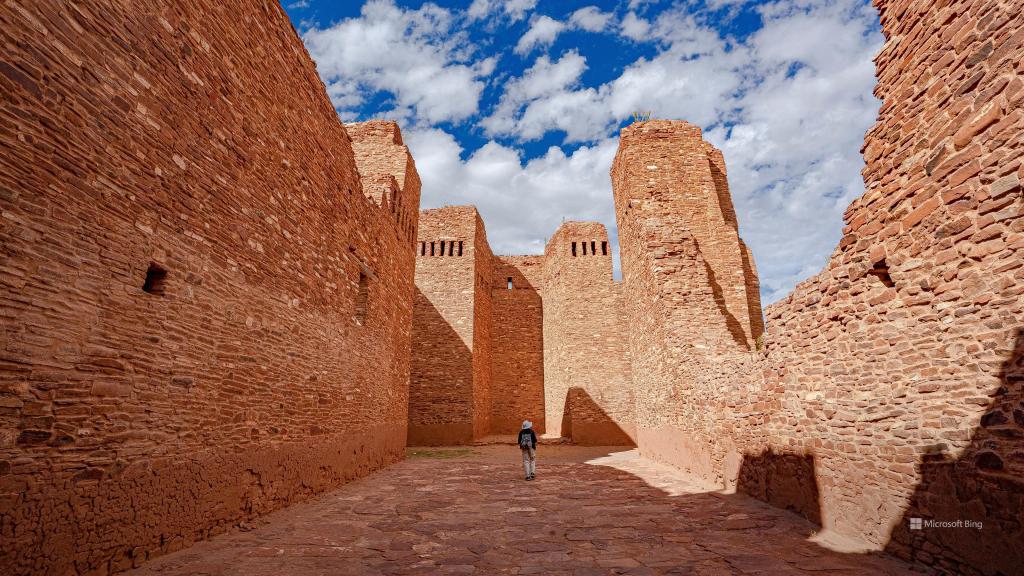
There are places in this world that exist outside of easy explanation. Places where the accumulated weight of human longing, labor, grief, and prayer has soaked into the earth itself, where time moves differently, where the boundary between what was and what is becomes permeable in ways that defy the rational mind. Quarai is such a place. Set quietly in the open expanse of central New Mexico, its red sandstone walls rising from the high desert scrub of the Manzano Mountain foothills, it is a site that resists being reduced to history alone. You can explain it. You can date it, categorize it, place it neatly within the narrative of Spanish colonization and Indigenous resilience. But standing there, inside those roofless walls with nothing overhead but the infinite blue of the New Mexico sky, that explanation feels not wrong but simply insufficient. Quarai is not just something that happened. It is something that remains.
The approach matters more than most visitors expect. The ruins do not announce themselves. They do not rise dramatically from a bare plain demanding attention. Coming in on foot through piñon and juniper, the smell of high desert sage filling the air, the sound of the ancient spring threading through the quiet, you pass through something before you arrive anywhere. The world narrows. The noise of ordinary life fades. Your body begins to understand, before your mind catches up, that you are entering different ground. And then through the brush and cottonwood the red sandstone walls appear, partially hidden, rising from the landscape the way something rooted rises, not imposed but grown, as though they have always been here and always will be. The Manzano Mountains hold the horizon behind them, faint and blue, ancient and indifferent. By the time you reach the ruins you are already moving differently. Slower. More deliberate. More awake.
Long before the Spanish arrived, Tiwa-speaking Pueblo people built a thriving community here, drawn by the rare reliable spring and sustained by a relationship with the land that required not domination but balance. Between water and drought, isolation and trade, the physical and the spiritual. The nearby salt flats connected Quarai to distant communities across the Southwest. Life here was not easy, but it was rooted, intentional, and woven through with ceremony and meaning. These were people who understood that the world was alive, that stones and water and sky were not backdrop but presence, not resource but relation. In the early 1600s that world was violently rearranged. Franciscan missionaries arrived carrying a different cosmology and the force of empire behind it, and with Pueblo labor, coerced and unrelenting, raised the massive church of La Purísima Concepción, its walls forty feet high and four feet thick, its sandstone the same deep red as the earth from which it was drawn. For a time the two worlds existed side by side, not fully merged and not fully separate, each maintaining its own ceremonies, its own relationship to the sacred. By the 1670s the balance shattered. Drought stripped the harvests. Raiders struck from the east. Disease moved silently through families and generations. The people of Quarai walked away, those who had survived, and the church they had built with their hands and their suffering was left to the sky and the wind and whatever had been present at that spring long before any human being had set stone upon stone.
Whatever that presence was, it did not leave with them.
Stepping into the nave is a different experience than approaching the ruins from the outside. The walls still hold the shape of the space, catching light and shadow in ways that feel less like accident than intention. The roofless opening above frames the sky, that specific saturated blue of the high desert at elevation that seems to vibrate slightly against warm stone, that seems to breathe. Your body still registers enclosure even as your eyes find nothing but open air above. It is both ruin and living structure, both absence and presence, both the thing that was and the thing that continues. A functioning sacred space is managed and contained, its energy channeled through liturgy and architecture and the schedule of devotion. But a roofless nave open to the sky is something altogether different. The boundary between interior and exterior dissolves. The space is consecrated but uncontrolled, held in a permanent threshold condition that every tradition across every culture recognizes as sacred in its own right. The liminal. The in-between. The place where ordinary categories loosen their grip.
This is where the phrase “the veil is thin” stops being metaphor and becomes description.
The concept appears across traditions so distant from one another that the convergence feels significant. Celtic Christianity spoke of thin places, locations where the membrane separating the human from the divine had worn nearly transparent. Indigenous traditions throughout the Americas have long understood certain sites as gathering points for spiritual power, places where the energy of the land and the accumulated ceremony of generations creates something that can be felt rather than merely known. Mystics across every faith lineage have described particular locations where the usual noise of selfhood quiets and something older and larger becomes briefly, undeniably present. These are not the same belief systems. But they are pointing toward the same experience. And Quarai produces that experience with a consistency that cannot be explained by landscape alone, however beautiful the landscape is.
Run your hand along the wall and what you feel is not simply texture. It is time. The uneven surface shaped by four centuries of weather, the slight irregularity of the mortar, the warmth the stone holds long after the sun has moved elsewhere. The red sandstone is not a fixed thing in light. It shifts through the hours, glowing amber in the early morning, going flat and ochre at midday, deepening toward brown under cloud shadow, warming from within on overcast days as if the color comes from inside the stone rather than from anything falling on it. To put your hand against that wall is to collapse distance in a way that nothing intellectual can accomplish. The structure stops being something to observe and becomes something to touch, something that receives your touch in return, something that was shaped by hands not so different from your own and that has been waiting, in whatever way stone waits, ever since.
The small things accumulate until they are not small. The shift of light across the nave floor. The movement of air through spaces where doors once stood. The distant shape of a hawk crossing a sky stacked with monsoon clouds, a single dark silhouette carrying something of the place’s solitude in its flight. Time loses its linearity here. The Pueblo community that once gathered in this valley, the hands that quarried and lifted and placed each stone, the prayers spoken in Tiwa and Spanish and perhaps in no language at all, the catastrophic departure and the long centuries of open sky afterward, all of it layers beneath your feet rather than receding behind you. The past at Quarai is not past in the way the past usually is. It is present. Not visible, not fully available to understanding, but undeniably, quietly, persistently present.
On one early visit a park ranger pointed upward without saying much. Tucked into the ancient stone near the top of the nave wall, almost perfectly hidden against the red sandstone, was a nest of baby owls. Small, still, watching with the ancient patience owls carry in their faces. The moment was brief and simple and it changed something. The oldest human structure for miles, raised with extraordinary labor and grief and devotion and the suffering of people who did not choose the task, had become a nursery. The owls were entirely at home. They were more at home than anyone had been in three hundred and fifty years. And there was something in that image, life nested inside ruins inside the desert inside an enormous indifferent sky, that felt like the place offering something. A sign in the old sense, not a supernatural message but a moment of sudden transparency, where the ordinary and the sacred briefly occupied the same space without apology.
Quarai is not a place that yields itself in a single visit. It deepens. Each return brings a different quality of light, a different season, a different interior weather, and the place meets each of these with something new. The familiarity does not diminish the experience but refines it, the way repeated reading of a great poem does not exhaust the poem but opens it further. The place becomes less something you visit and more something you are in ongoing conversation with, a conversation conducted largely in silence, in sensation, in the particular quality of attention the ruins seem to require and to reward.
What Quarai asks of those who enter it is not belief in any particular framework. It does not require that you bring a tradition or a theology or even a vocabulary for what you are experiencing. It only asks that you slow down enough to receive what is there. That you place your hand on the stone. That you lift your eyes to the open sky and allow the accumulated weight of this place, the longing and the labor, the ceremony and the catastrophe, the long silence and the persistent spring, to settle over you like the shadows the walls cast in the late afternoon light.
There is something here. Not something you can name exactly, and the naming would diminish it anyway. Something that the Tiwa people who lived here knew in their bones. Something the Franciscan friars, whatever their failures, were perhaps genuinely reaching toward when they raised these walls in the desert. Something the owls know without knowing, nested in the warm stone, indifferent to history and at home in the sacred.
The veil is thin here. You feel it. And you come back, again and again, because a place that does that to you is not a place you leave entirely. It travels with you. It waits for you. It is, in whatever way places can be, yours.


Leave a comment