The Battle of Valverde: The Civil War Came to New Mexico
When most Americans think of the Civil War, they picture the green hills of Virginia or the red clay of Georgia. Few know that in February 1862, one of the war’s most dramatic chapters unfolded along the sandy banks of the Rio Grande, right here in New Mexico.
The Battle of Valverde, fought on February 20–21, 1862, was no minor skirmish. It was the largest Civil War battle ever fought in the Rocky Mountain West, and its outcome nearly changed the fate of the entire American Southwest.
What Was at Stake
Confederate General Henry Hopkins Sibley had a bold, almost audacious vision: lead his Army of New Mexico, roughly 2,500 Texas volunteers, northward through the territory, seize Santa Fe, and ultimately push west to claim California for the Confederacy. If successful, the South would become a transcontinental nation with Pacific ports, access to Colorado goldfields, and a far stronger hand for winning diplomatic recognition from Europe.
Standing in his way was Union Colonel Edward R.S. Canby at Fort Craig, a man Sibley knew well. The two had served together in the U.S. Army and were not just colleagues but friends. In one of the Civil War’s many painful ironies, Sibley now led an invading army against his old comrade. Canby commanded a remarkably diverse force of over 3,800 men: U.S. Army regulars, Colorado gold miners, and Hispano volunteers of the 1st New Mexico regiment under the legendary Kit Carson. These New Mexican men had enlisted to defend their own homes and families, defying Sibley’s assumption that locals would welcome the Confederates.
The Fight at the Ford
Unable to take Fort Craig by direct assault, Sibley swung his army east of the Rio Grande, hoping to seize the Valverde ford six miles north and cut Union supply lines. Canby moved to stop him.
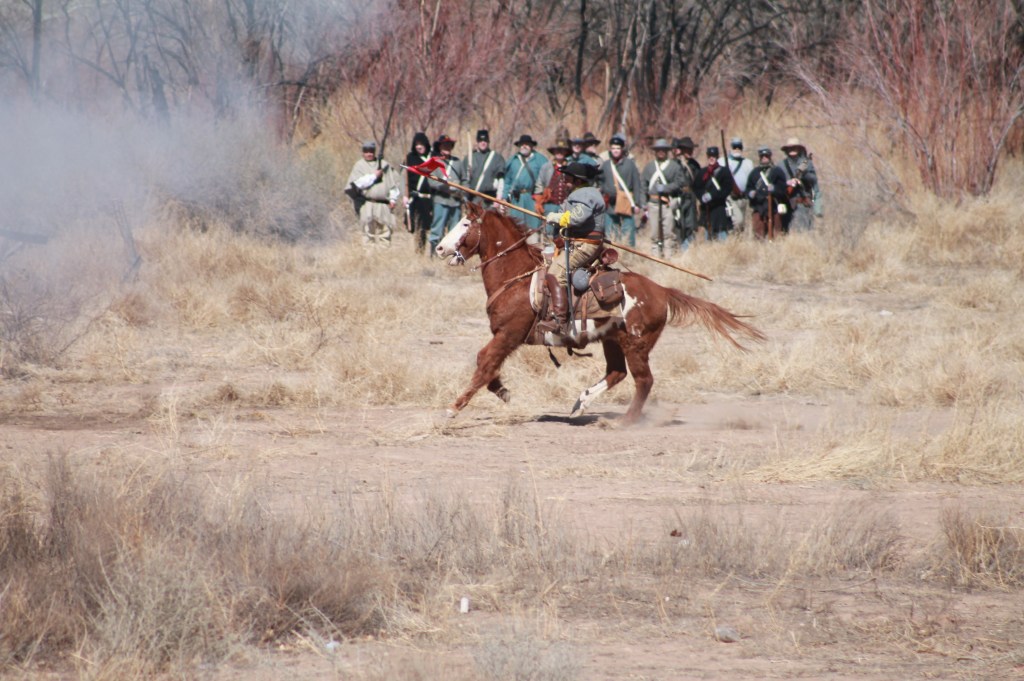
The battle that followed was brutal and chaotic. Fighting raged across the dry riverbed and sandy plain through the afternoon. In one of the war’s most unusual moments, a Confederate lancer company charged the Union line, the first and last lancer charge of the entire Civil War, and was repulsed with devastating losses.
In the end, Colonel Tom Green, standing in for a mysteriously “ill” Sibley who was reportedly keeping company with a whiskey bottle, spotted a gap in the Union line and ordered a bold frontal charge. The Confederates captured six Union artillery pieces and turned them on the retreating Federals. Canby’s forces fell back to Fort Craig.
Technically, it was a Confederate victory. But it came at enormous cost, and Sibley’s battered army lacked the strength to take Fort Craig. He pushed north, occupied Albuquerque and Santa Fe, and then lost everything at the Battle of Glorieta Pass five weeks later. Within four months, the Confederate dream of a western empire was finished.
Why It Still Matters
Valverde is one of America’s most overlooked battlefields, yet its story is rich with complexity: questions of loyalty, identity, and who gets to define what they’re fighting for. The Hispano volunteers of New Mexico, the Colorado miners, the Texas cavalrymen, all of them came to a ford on the Rio Grande believing deeply in their cause. And somewhere in the middle of it all, two old friends found themselves on opposite sides of the fight.
Reenactments like the 2018 event captured in the video above keep that story alive. History isn’t just in textbooks. Sometimes it’s in the dust and the smoke and the faces of people willing to remember.
Interested in visiting the site? Fort Craig Historic Site, managed by the Bureau of Land Management, is open year-round and offers a self-guided trail near Socorro, New Mexico.


Leave a Reply