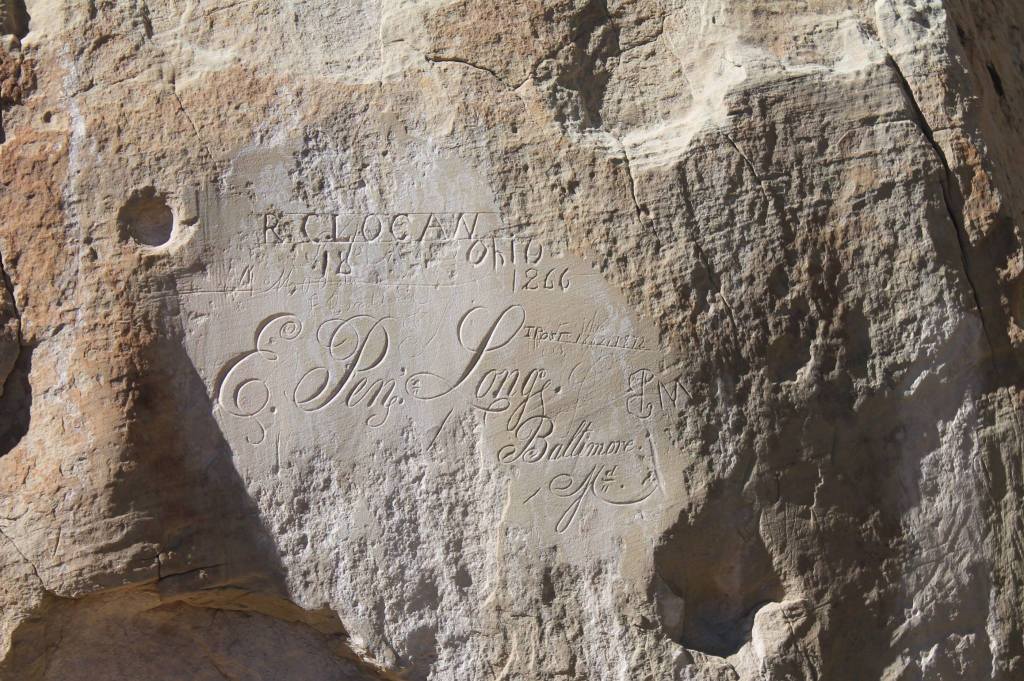
Where the Desert Remembers: The Names at El Morro
There are places in New Mexico where history does not feel distant. El Morro National Monument is one of them.
At first glance, El Morro is simply a towering sandstone bluff rising out of the high desert west of Grants, glowing red and gold beneath the endless western sky. But beneath the beauty is something far more human. For centuries, travelers came here because of water. A reliable natural pool at the base of the cliffs, still and clear beneath the stone, made this place essential in an unforgiving landscape. Standing beside it, you understand immediately why no one passed through without stopping. In a country of dry arroyos and punishing distances, this pool was life.
Indigenous peoples knew it long before Europeans arrived. The Ancestral Puebloans who built the village of Atsinna atop the bluff likely lived here for generations, and this place was not a waypoint for them. It was home. Atsinna, whose ruins still stand above the monument today, housed hundreds of people at its height. Families farmed the surrounding land, traded across wide distances, and understood this landscape in ways no passing traveler ever could. The petroglyphs carved into the sandstone, spirals, figures, symbols whose meanings we can only partially read now, predate the Spanish inscriptions by centuries. They are the oldest voices in the stone.
That history matters when you walk the trail and begin reading the later inscriptions. The landscape was never empty wilderness waiting to be discovered. It was known. It was remembered. Every European who arrived and carved his name into these walls was adding himself to a story already centuries old.
And still, the inscriptions are remarkable.
The sandstone walls beside the pool are covered in them, some dating back more than four hundred years. Standing there today feels strangely intimate. The names are not trapped behind museum glass. They remain exactly where the travelers carved them, exposed to sun, wind, rain, and time.
One of the most famous belongs to Juan de Oñate, who passed through in 1605 during an expedition north from New Spain. His inscription remains carefully preserved in the stone, a reminder of the earliest Spanish colonial movement into what would become New Mexico, a movement that brought catastrophic consequences for the Pueblo peoples already living here. Nearby are inscriptions left by governors, soldiers, priests, scouts, and travelers whose journeys shaped the region’s history in complicated and lasting ways.
Later travelers added their own marks. American Army officers carved names there during westward expansion. Surveyors mapping unfamiliar territory paused long enough to leave evidence of their passing. Some inscriptions are elegant and formal, carefully chiseled into the sandstone like permanent declarations. Others are rougher and more hurried. A date. A name. Proof that someone survived the journey long enough to stop at this life-giving pool beneath the cliffs.
What struck me most was how ordinary many of the names feel.
History books often reduce people to titles and events, but at El Morro you encounter them as human beings. Tired travelers. Young soldiers. Men carrying dust on their boots and uncertainty about what waited ahead. Some were explorers pushing into unfamiliar country. Some were probably homesick. Some may have been frightened. Most were almost certainly exhausted.
And still they paused to carve their names into stone.
There is something deeply recognizable about that impulse. Long before photographs or social media or GPS check-ins, people wanted to say the same thing we still say now: I was here.
El Morro preserves all of it together beneath the same desert light: the petroglyphs, the Spanish inscriptions, the American names, the ruins above. The cliffs do not sort the stories by morality or significance. They simply hold them.
And maybe that is what makes the place feel so powerful.
Standing there reading those weathered names, with ravens overhead and wind moving through the piñon trees, I found myself thinking about how brief human lives really are compared to the landscapes we move through. Most traces we leave disappear quickly. But here, some remain for centuries.
Not because the people were famous.
Because they stopped, looked at the stone, and wanted to be remembered.
El Morro National Monument is located along US-53, approximately 56 miles west of Grants and 43 miles east of Zuni. The monument is open year-round. The Inscription Rock trail is an easy half-mile loop, while the full mesa trail adds another two miles and climbs to the Atsinna ruins. Bring water, wear sun protection, and give yourself more time than you think you need. The names in the stone deserve a slow read.


Leave a comment