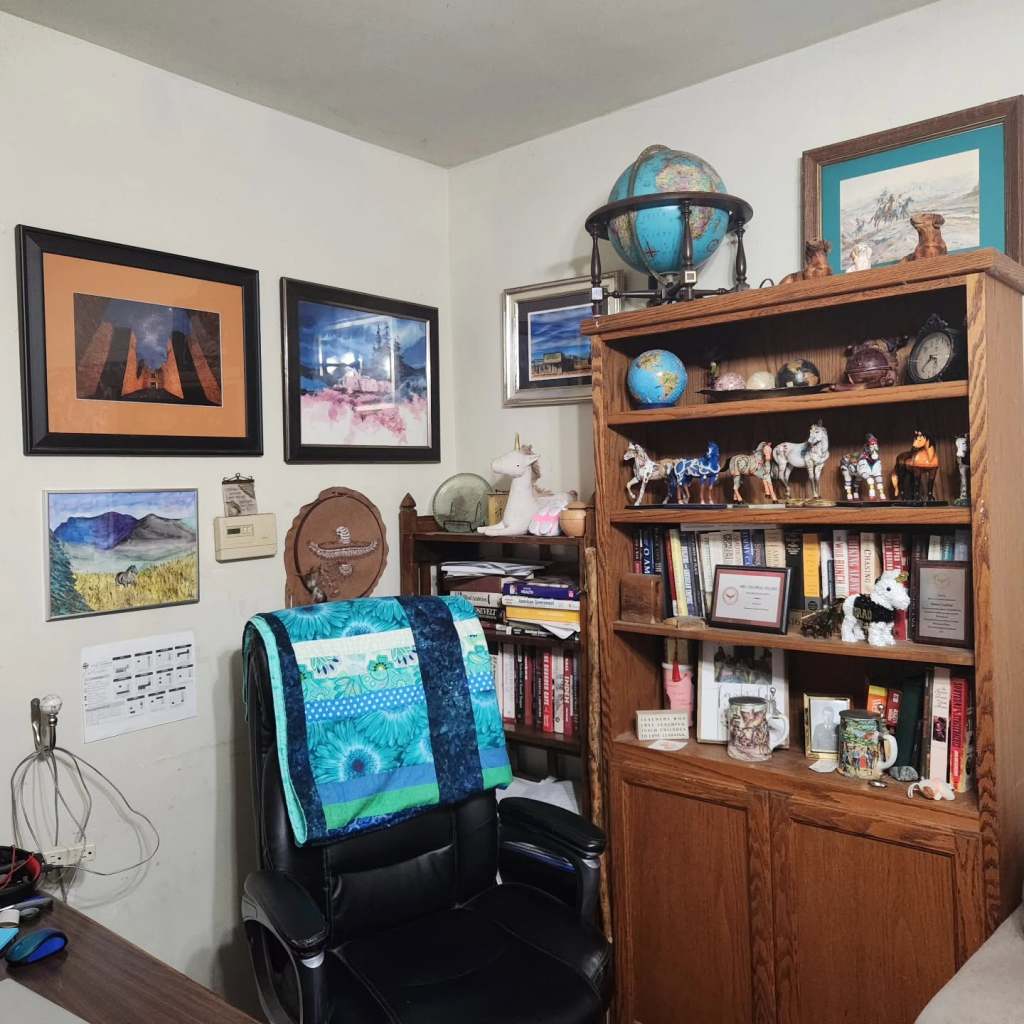
Every August, I reorganize my classroom to prepare for a new school year.
Every class is different, and I like to give each one a fresh start. I move books, rethink displays, straighten shelves, and occasionally find a better home for something that has been sitting in the same place for years. Sometimes I even replace a bookshelf that has finally decided its career is over.
The maps stay.
The globes stay.
The history books stay.
Then there are the pirate books.
And the cowboy books.
Yes, I have enough of both to have their own sections.
Students sometimes ask why.
The answer has very little to do with pirates or cowboys.
This summer, as I reorganized my classroom for another school year, I found myself carrying box after box of books from my house. Some had been collected over years of teaching. Others had come from estate sales, where I unknowingly inherited pieces of someone else’s library, rescuing someone else’s passions and giving them a second life in my classroom. Two different estate sales are responsible for most of my pirate and cowboy books. I bought several from each collection simply because they looked interesting.
Some of those books stayed home.
Many earned a place in my classroom.
As I shelved them alongside my maps and globes, I realized something.
A classroom says a great deal about the person who teaches there.
Walk into my room and you’ll see books on American history, geography, the Civil War, the American West, exploration, pirates, and New Mexico. You’ll find maps on the walls and globes waiting to be spun. There are photographs I’ve taken while hiking, artifacts I’ve collected, and shelves filled with books that have captured my curiosity over the years.
None of those things are there by accident.
They’re certainly not there because they’re required by a curriculum guide.
They’re there because they represent the things that have captured my curiosity over a lifetime.
I’ve always believed students can tell the difference between a teacher who teaches a subject and one who loves it.
History isn’t just a job to me. Geography isn’t just another class on my schedule. They are ways of understanding the world.
Every map tells a story. Every old photograph raises a question. Every book opens another door — sometimes to the Colorado high country, sometimes to the streets of ancient Rome, sometimes aboard a pirate ship crossing the Caribbean, sometimes riding alongside a cattle drive moving north across the Great Plains. You never know where the next one leads, and that not-knowing doesn’t stop at graduation. It doesn’t stop when you become the teacher, either.
I don’t expect every student to read every book on my shelves. I don’t expect every student to become a historian or a geographer.
But I do hope they become curious.
Maybe one student notices a globe and wonders why country borders change over time. Another pulls a pirate biography off the shelf because the cover catches their eye. Someone else flips through a book about cowboys and realizes the American West was far more complex than the movies suggested.
Those moments won’t appear on a test.
They may not even happen during a lesson.
But they matter.
Twenty-three years into my career, I’m still stopping at estate sales because I might find a fascinating history book. I’m still buying maps. I’m still collecting books. I’m still learning.
And I hope my students see that.
Curiosity doesn’t have an expiration date.
So yes, my classroom is filled with maps, globes, pirates, and cowboys.
Not because they’re required.
Because they remind me — and I hope my students — that the world is endlessly fascinating. There is always another map to unfold, another story to discover, and another question worth asking.
If my students leave my classroom remembering only one thing beyond history or geography, I hope it’s this:
Never stop being curious.


Leave a comment