The People Who Made the Award Matter
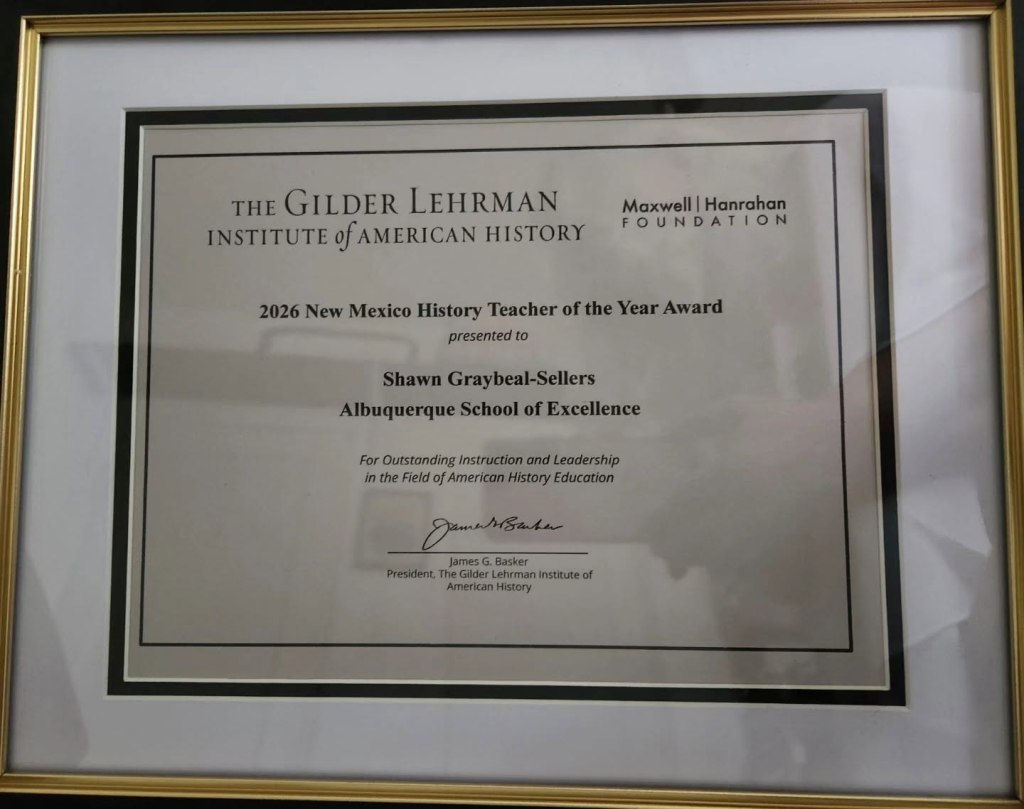
On Wednesday, I was honored as New Mexico’s Gilder Lehrman History Teacher of the Year. There was a framed certificate, flowers, pictures, and people saying very kind things about me, and I was happy to stand there and accept all of it. I was proud of the award and proud of the work it represents.
Then I went back to school, because apparently being named History Teacher of the Year does not come with a grading fairy. I checked. There were still papers on my desk.
But something happened after the ceremony that ended up meaning almost as much to me as the award itself.
I posted a picture on social media, and by the next evening more than a hundred people had reacted to it. There were friends and family, colleagues and people I’ve known at different points in my life, but as I scrolled through the names, what struck me was how many of them belonged to former students.
Some of them were kids when I taught them and are now very much adults, with careers and families and lives of their own. Some left my classroom only a few years ago, while others sat in front of me a very long time ago. Yet there they were, taking a moment out of their lives to be happy for their old history teacher.
That got me.
I’ve been teaching for more than twenty years, and one of the things I’ve learned is that you don’t always get to know what mattered. I can tell you what I taught because I have lesson plans, PowerPoints, assignments, and an alarming number of files on my computer to prove it. I can tell you that we studied the Constitution, the French Revolution, the causes of World War I, and hundreds of other things.
What I can’t always tell you is what a student carried out of the room.
Maybe they remember the Battle of Kings Mountain because their teacher got ridiculously excited while talking about a group of backcountry militiamen who decided Patrick Ferguson’s threats were a spectacularly bad idea. Maybe they remember a song I played, a story I told, something another student said during a discussion, or a conversation that had almost nothing to do with the lesson. Maybe they don’t remember much of the history at all, and honestly, that’s okay too.
A few days ago, I was telling one of my classes about the Battle of Kings Mountain and mentioned that I’ve always wondered why such a remarkable story has never been made into a movie. One of my students immediately had an answer.
“Because they’re waiting for you to write it.”
I laughed, but I’ve thought about it ever since.
That is one of the remarkable things about students. Sometimes, without even realizing they are doing it, they hand something back to you. For years, I’ve been the person at the front of the room telling kids that their ideas matter, encouraging them to ask another question, dig a little deeper, take a chance, and try something even when they aren’t entirely certain they can do it. Every once in a while, they turn around and do exactly the same thing to me.
My students have done that with my writing, too, and The Space Between Songs is dedicated to them for a reason.
I am a newly published novelist, but I am not a new writer. I started writing seriously around the same time I started teaching, and I have been telling stories for as long as I can remember. Teaching and writing grew together, and somewhere along the way they became so tangled up in each other that I’m not sure it would be possible to fully separate one from the other. More than twenty years of telling stories about people who lived before us, trying to make distant places and times feel real, and asking students to think about why human beings make the choices they do have inevitably shaped the way I write fiction. But I think it works in the other direction, too. Being a storyteller has shaped the kind of history teacher I became.
I don’t think I’ve ever simply taught history. I’ve always told it.
History is full of stories, and the names in textbooks belonged to complicated human beings who were scared and brave, who loved people, lost people, and were sometimes spectacularly wrong. I want my students to understand what happened, but I also want them to understand that real people lived through it. Maybe that is why I can still get ridiculously excited about Kings Mountain after all these years, and maybe it is also why a student can hear that excitement and tell me that perhaps I should be the one to write the story.
Through all those years, my students have shaped both the teacher and the writer—the loud ones and the quiet ones, the ones who loved history before they ever entered my classroom and the ones who absolutely did not, the ones who challenged me, the ones who made me laugh, the ones who occasionally drove me a little crazy, and the ones who came back years later to tell me what they were doing with their lives. They are part of the story, too.
I am proud of that framed certificate. I’m proud of the work it represents, I’m grateful to the Gilder Lehrman Institute for the recognition, and seeing my name attached to the words History Teacher of the Year is pretty damn cool. I’m not going to pretend otherwise.
But when I looked at that post and saw name after name of former students, I was reminded that an award can recognize the work, but it can’t really measure what more than twenty years in a classroom have meant.
For that, I only have to look at the people who were there.
The award recognizes the work. The students are the reason the work matters.


Leave a Reply